
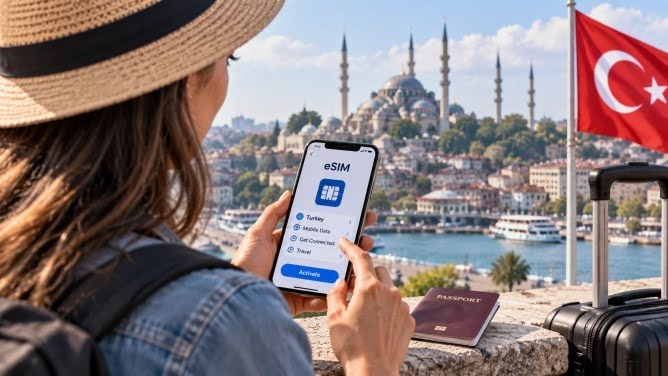
Visitors planning a trip to Turkey should be aware of new limitations on accessing several international eSIM provider platforms. While these restrictions do not prevent the use of eSIM technology on compatible smartphones, they can complicate the process of reaching certain provider websites and applications once in the country. These measures were introduced by Turkey’s Information and Communication Technologies Authority (BTK) in July 2025, effectively blocking access to certain international eSIM provider domains. Among the affected providers are Saily, Airalo, Holafly, Nomad, Instabridge, Mobimatter, Alosim, BNESIM, FlexiRoam, and Roamless, with more being added over time.
For travelers, understanding the difference between an eSIM being blocked and a provider’s online services being inaccessible is crucial. An eSIM profile previously installed may still connect to a supported network within Turkey. However, challenges arise when a traveler attempts to purchase a new plan, download activation information, seek support, or add data after arriving. To mitigate potential issues, it is advisable to set up connectivity before departure, ensuring that the phone supports eSIMs, completing installation with a reliable internet connection, and saving activation information offline.
eSIM Prime continues to offer its services in Turkey, claiming operational stability through partnerships with Turkish mobile operators like Turkcell and Türk Telekom. For those evaluating eSIM options for Turkey, factors such as accessibility, pricing, data limits, network coverage, and validity should be considered. Arranging for a plan that can be purchased and managed before traveling may prove more convenient than relying on a provider whose online services might become inaccessible upon arrival.
Alternatively, visitors can consider local SIM services from operators such as Turkcell, Vodafone Türkiye, and Türk Telekom, especially for extended stays or when a Turkish phone number is necessary. Acquiring a local SIM might involve visiting a retail store and completing identification procedures. In contrast, travel eSIMs offer convenience for shorter visits, as they can typically be set up online in advance, providing data-focused plans for various online needs without requiring a physical SIM switch.
Before selecting an eSIM for use in Turkey, travelers should verify several aspects: the accessibility of the provider’s website and app from within Turkey, the possibility of purchasing and installing the eSIM before departure, the Turkish mobile networks utilized by the service, and whether the plan includes data only or also supports calls and SMS. Additionally, travelers should consider how to access customer support if the provider’s app becomes inaccessible, whether top-ups can be conducted via alternative web channels, and the plan’s data allowance, validity, and coverage. While Turkey’s restrictions have altered the landscape of eSIM connectivity, preparing adequately before the trip can help ensure seamless connectivity upon arrival.
Legal Disclaimer: The information contained in this article has been provided by independent third-party contributors, clients, or content partners. We do not independently verify the accuracy, completeness, legality, ownership, licensing, or reliability of submitted content, including text, images, videos, trademarks, or other media materials. The submitting party is solely responsible for ensuring that all content, including images and media assets, complies with applicable copyright, trademark, licensing, and intellectual property laws. We disclaim liability for any unauthorized use of copyrighted or proprietary materials by third parties. If you believe that any content published on this platform infringes your intellectual property rights, kindly contact the author above for prompt review and resolution.